

AI in architectural visualization: beautiful is not the same as accurate
Press/ AI in Architectural Visualization - 8 min read - June 2026
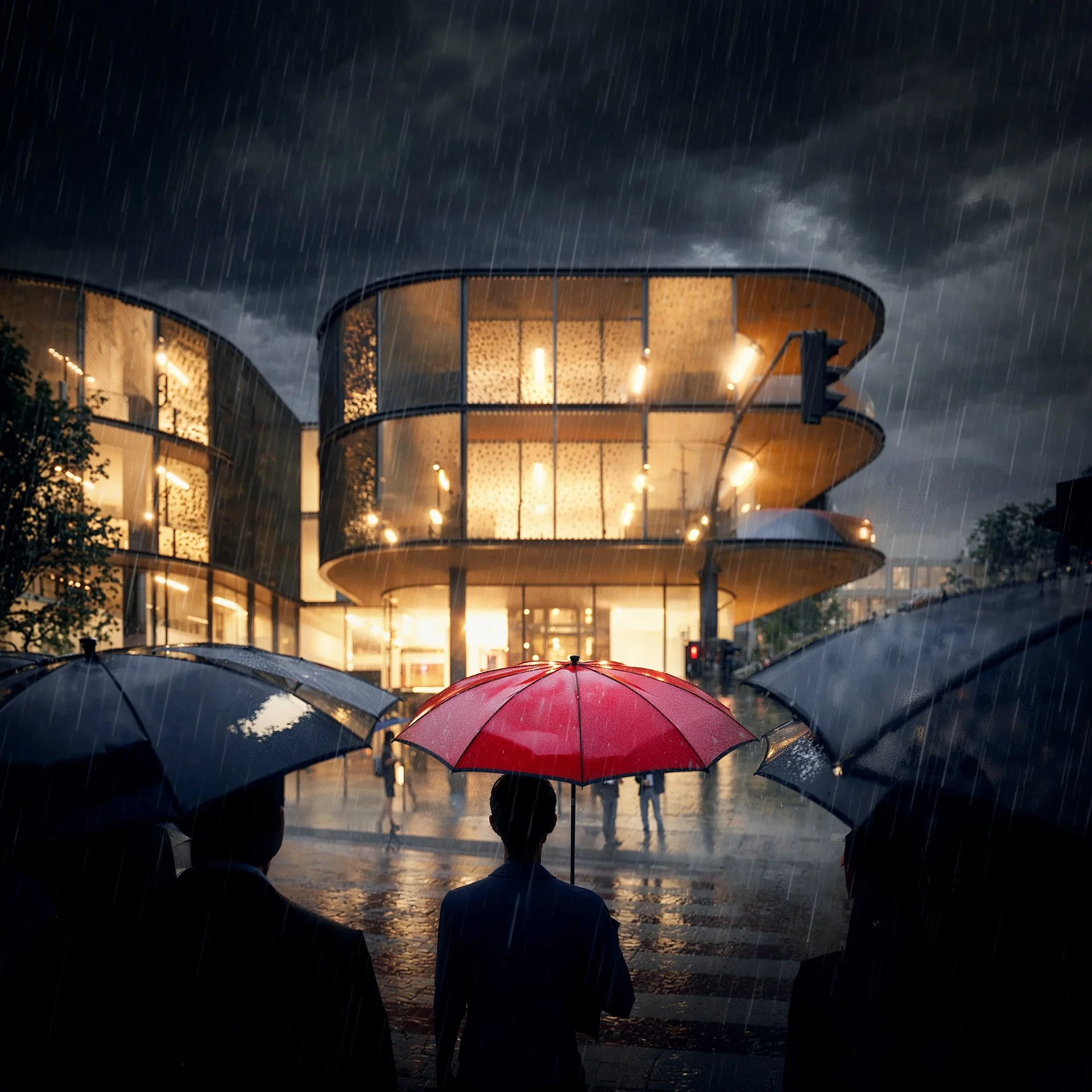
There is a version of this article that defends traditional CGI against the rise of AI. This is not that article.
AI is here. It is not going away. And anyone still positioning themselves as being "against" it is having the wrong conversation. The more honest question, the one architects and developers should actually be asking, is not whether to use AI in architectural visualization, but where it earns its place and where it quietly misleads you.
After ten years in this industry, working inside studios like Brick Visual, Walktheroom, and The Boundary before founding Storyform Studio, I have a clear view of what AI does well, what it does poorly, and what it has changed permanently. Here is what I actually think.
Architectural visualization is not about images. It is about trust.
When an architect presents a visualization to a planning committee, they are saying: this is what will be built. When a developer shows renders to investors, they are making a commitment. When a marketing campaign goes live around a building that does not yet exist, the images carry legal and commercial weight. In every one of these situations, the visualization is not decoration. It is evidence.
That is a completely different standard than "does this look beautiful." Beautiful is easy. AI can produce beautiful in seconds. What it cannot produce, at least not reliably, is accurate, controllable, and accountable. The exact material specification. The precise view angle the planning officer will examine. The way the building meets the ground. These things require deliberate decisions, made by someone who understands both the craft and what is at stake for this specific project.
Trust is built through precision and consistency. It is built when a client can point to an image and say: this is what we agreed. It cannot be generated in seconds, and it cannot be outsourced to a model that does not know the building, the client, or the context.
That is the lens through which everything else in this article should be read.
Control has not moved. It has just shifted.
The most common misconception about AI in visualization is that it replaces judgment. It does not. What it replaces is time spent on specific, repeatable tasks. The judgment about what to make, how to frame it, what it should feel like and what it needs to communicate, that still lives entirely with the person directing the work.
This matters more than it sounds. The visualization artist is not just a pair of hands executing instructions. The artist is the one who reads the brief underneath the brief, who understands that the architect wants the building to feel grounded even if they have not used that word, who knows that this developer's investor presentations always need images that feel aspirational without feeling unreal. That knowledge is not in any training dataset. It comes from experience, from conversation, from understanding the human context around the project.
An AI tool given a vague brief produces a vague result, only faster. Give it a sharp brief, one informed by experience, taste, and a clear understanding of the building and its audience, and it can accelerate your process significantly. But that brief has to come from somewhere. It comes from the artist.
Speed is what AI offers. Intelligence about what a project needs, and what an image needs to do, remains entirely in human hands.
Everything that moves fast is hard to control.
There is a principle that holds across most creative work: speed and control exist in tension. A fast sketch is loose. A fast render is atmospheric but imprecise. A fast AI generation is often striking but rarely accurate in the ways that matter for a real architectural project.
This is not a criticism of AI in architecture. It is just how creative process works. When you compress the time a task takes, you compress the number of decisions that get made. And in architectural visualization, many of those decisions are load-bearing. The proportion of a window. The way a material reads at a specific scale. The relationship between the building and the ground it sits on. Get these wrong and the image is useless, regardless of how beautiful it is.
AI-generated architectural imagery has a recognizable quality right now. A certain smoothness. A certain way light behaves. A confident atmosphere that communicates mood without committing to specifics. For some purposes that is exactly right. For others it is precisely the problem.
Where AI genuinely belongs: the concept phase.
Where AI earns its place without qualification is in early-stage concept work. The ability to generate dozens of atmospheric directions quickly, to shift mood, material palette, and massing in minutes rather than days, to give a design team something to react to before the architecture is fully resolved, this is genuinely valuable for architects and visualization studios alike.
I have seen projects change direction because an AI-generated concept image revealed something the team had not articulated yet. A feeling, a quality of light, a spatial relationship that was latent in the brief but had not surfaced. Used well, AI in the concept phase is not about producing final architectural renders. It is about accelerating the conversation.
The risk is getting seduced by the output. A striking AI image in the concept phase can lock a direction prematurely, before the design has been tested properly. The images are confident. Confidence can be mistaken for resolution. This is where the artist needs to stay in control, using AI to generate options, not to make decisions.
People, detail, and storytelling: where AI has genuinely won.
If there is one area where AI has replaced a previous architectural visualization workflow almost completely and without loss, it is the integration of people into renders. Entourage used to be painstaking. Cutout libraries, manual compositing, scale and light matching, and still the figures often looked placed rather than present. AI handles this now at a quality level the old approach could rarely reach. Figures feel inhabited in the scene, not added to it.
But this is not just a workflow improvement. It is a storytelling improvement. People in a visualization do something no material or light quality can do: they make a space feel lived in. They tell the viewer what kind of life this building is meant to hold. A couple pausing on a terrace communicates something different to a developer's investor than a lone figure crossing an empty plaza. The right figures, in the right positions, doing the right things, are as much a narrative decision as a compositional one. AI has made executing that decision faster and more convincing.
The same applies to overall image detail. AI upscaling tools allow a scene built and rendered correctly to carry more texture, more surface quality, and more material depth than the raw render would show. The important word is "correctly." AI can enhance what is there. It cannot repair what is wrong. A badly proportioned facade gains sharper brickwork through AI and is still badly proportioned. The craft comes first. AI amplifies it.


Animation: AI as amplifier, not replacement.
The most exciting application of AI in architectural visualization right now, beyond stills, is in animation. The quality achievable today using AI-assisted workflows, in terms of atmosphere, motion, and overall production value, has increased substantially. Lighting passes that would have taken days can be explored in hours.
But here is what has not changed: the information that needs to go in. A good AI-assisted architectural animation still requires accurate geometry, a well-built scene, careful art direction, and a clear understanding of what the sequence needs to communicate. The AI does not replace that input. It amplifies it. Go in without those foundations and the AI produces impressive-looking confusion. The craft requirement has not disappeared. It has moved upstream.
The honest number: around 25 to 30 percent.
Not 80 percent. Not "ten times faster." Across a realistic architectural visualization workflow, from brief to final delivery, AI tools as they exist today have meaningfully reduced the time required, primarily in the middle stages: iterating materials, generating entourage, exploring lighting variations, producing supporting views.
The front end of the process, understanding the brief, making decisions about framing and narrative, building the geometry correctly, is largely unchanged. The back end, client review, revision management, final output, is also largely unchanged. What has compressed is the exploration phase in between. That is real and valuable. It is not a revolution.
Budget, beauty, and what you are actually buying.
At the lower end of the budget range, where the goal is to communicate a project's mood quickly, AI-generated architectural visuals can deliver results that are good enough. Atmospheric, presentable, directionally correct.
The limitation is not quality in the conventional sense. The limitation is control and commitment. AI-generated images communicate a mood. They do not communicate a specification. They cannot be precisely tied to a building's actual materials, proportions, or details in the way that a controlled production process can. For early marketing, for social content, for internal alignment on a design direction, that may be entirely acceptable.
For a planning submission, an investor deck built around specific commitments, or a marketing campaign where images will be compared to the finished building, the gap between mood and specification becomes the problem. The question to ask before any architectural visualization project is not "how much does this cost" but "what does this image need to do, and who needs to trust it."
The question worth asking before any project.
Not "should we use AI?" but "what does this image need to do?"
If it needs to create atmosphere quickly, orient a design conversation, or produce material for early stakeholder engagement, AI can help, significantly. If it needs to accurately represent a building that will be built, support a planning application, anchor a marketing campaign, or stand as a record of what was promised, it needs the precision that only a controlled architectural visualization process provides.
The best studios are using both, in the right places, with a clear understanding of which tool is serving which purpose. That is not a compromise. It is just good judgment.

Working on a project where you are unsure whether AI or traditional visualization is the right approach? Get in touch, we can talk through what your images actually need to do.

Norbert Dumitrescu is the founder of Storyform Studio, a premium architectural visualization practice based in Cluj-Napoca, Romania. He has spent ten years working with architects, developers, and visualization studios across Europe, US and UAE.